Aston Martin DB4 GT
FOR SALE

1959–1963 | 3.7-litre twin-plug straight-six | 302 bhp | 4-speed manual | approximately 75 Touring-bodied examples
The Aston Martin DB4 GT occupies a particularly distinguished place in the history of British grand touring automobiles. Conceived not simply as a faster DB4, but as a lighter and more focused competition machine, it brought together the elegance of the DB4 with a level of performance and agility intended to challenge the very best GT machinery of its era.
Introduced at the London Motor Show in October 1959, the DB4 GT represented a decisive evolution of the DB4 formula. Its chassis was shortened, its body made considerably lighter, its cabin reduced to two seats and its Tadek Marek-designed straight-six engine given a more highly developed specification.
The result was a car that looked every inch an Aston Martin grand tourer, yet possessed the character of a genuine racing machine.
Aston Martin described the DB4 GT as a car equally at home on road and track. Its competition credentials were established almost immediately, when the prototype DP199/1, driven by Sir Stirling Moss, won its GT class at Silverstone and set a new lap record.
Why Was the DB4 GT Designed?
The DB4 had already established Aston Martin as a serious manufacturer of high-performance grand touring cars.
Introduced in 1958, the DB4 represented a new generation for the company. Its elegant Carrozzeria Touring bodywork, advanced six-cylinder engine and impressive performance placed Aston Martin firmly among Europe’s leading sporting manufacturers.
But the world of international GT racing demanded something more.
A standard DB4 was a sophisticated four-seat grand tourer, but its weight and dimensions inevitably limited its potential against lighter and more focused competition.
Aston Martin’s answer was the DB4 GT.
Rather than simply increasing engine power, the engineers concentrated on the fundamental principles of competition-car design: less weight, a shorter wheelbase, greater power and sharper handling.
The DB4 GT therefore became a concentrated version of the DB4 philosophy.
It was smaller.
It was lighter.
It was more powerful.
And, critically, it was designed to be competitive on a racing circuit.
Design & Proportions
At first glance, the DB4 GT appears unmistakably related to the DB4.
Look more closely, however, and the differences become apparent.
The wheelbase was shortened by five inches, reducing the distance between the axles and giving the car a more compact and purposeful stance. The body was also shorter and lighter, while the traditional four-seat configuration was replaced by a strict two-seat cabin.
The front of the car was particularly distinctive.
Many examples featured faired-in headlamps, giving the DB4 GT a smoother and more aerodynamic appearance than the standard DB4.
The overall result was beautifully proportioned.
The long bonnet remained, preserving the visual identity of the DB4, but the shorter cabin and rear bodywork gave the GT a considerably more sporting character.
This was not styling for styling’s sake.
Every significant alteration served the same objective: reduce mass and improve performance.
Carrozzeria Touring & Superleggera Construction
The DB4’s elegant shape originated from Carrozzeria Touring of Milan, whose influence was fundamental to the model’s identity.
Touring’s famous Superleggera, or “super-light”, construction technique used thin aluminium panels formed over a lightweight tubular framework.
For Aston Martin, the system provided an elegant solution to a difficult engineering problem.
The structure could remain sufficiently strong while reducing body weight, and the resulting panels could be shaped into the flowing forms that became synonymous with the DB4 family.
Aston Martin worked with Touring under licence, with the Newport Pagnell factory undertaking the construction process using Touring’s principles and body jigs.
For the DB4 GT, the lightweight philosophy was taken considerably further.
The body used thinner-gauge aluminium construction, while the shortened chassis and reduction in equipment contributed to a substantial weight saving.
Aston Martin’s own historical material records the DB4 GT as approximately 85 kg lighter than the standard DB4, while another factory technical archive describes the reduction as approximately 185 lb.
The difference was significant.
In a competition car, removing weight is often more valuable than simply adding power.
The DB4 GT embodied that principle.

The Shortened Chassis
The DB4 GT’s wheelbase was reduced by five inches compared with the standard DB4.
This seemingly modest alteration transformed the character of the car.
A shorter wheelbase reduced the car’s polar moment of inertia and allowed it to change direction more readily.
The DB4 GT therefore felt more immediate and responsive than its larger sibling.
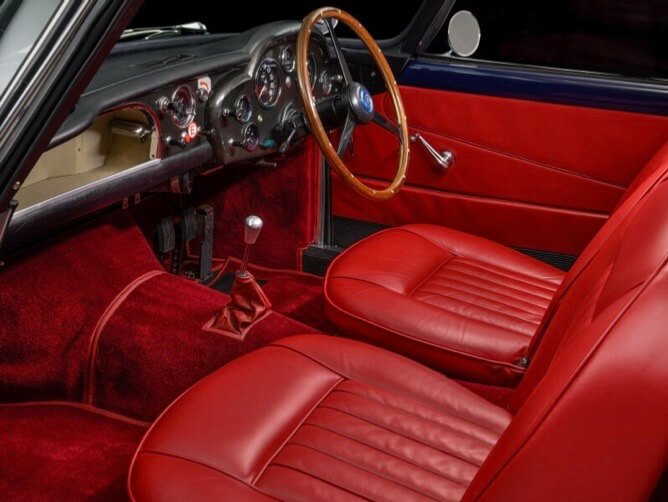
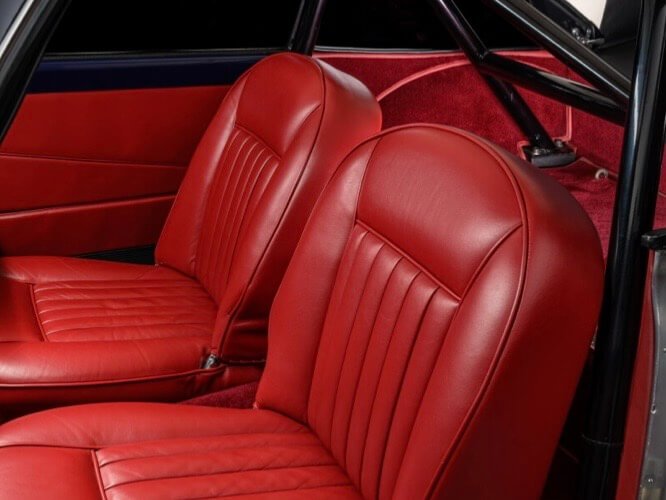
The two-seat configuration also contributed to its competition character.
The car was no longer attempting to serve as a luxurious four-seat grand tourer first and sporting car second.
The priorities had changed.
The DB4 GT was created with the circuit in mind.
We discreetly source and place vehicles of this calibre for private clients.
The Engine
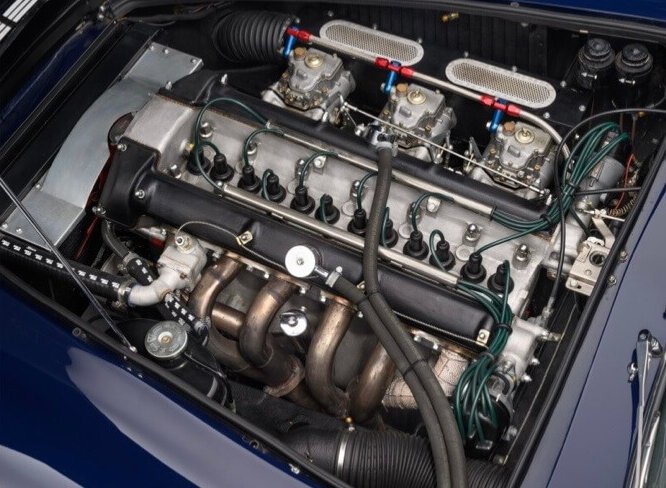
At the centre of the DB4 GT was Tadek Marek’s sophisticated 3.7-litre straight-six.
The engine retained the fundamental architecture of the DB4 unit but received significant performance-oriented modifications.
One of the defining changes was the use of two spark plugs per cylinder, improving combustion efficiency and helping the engine produce its increased output.
Triple Weber carburettors were employed, while the compression ratio was raised to 9:1.
The factory specification quoted approximately 302 bhp at 6,000 rpm, a remarkable figure for a 3.7-litre road-going engine of the period.
The engine was paired with a four-speed manual transmission and drove the rear wheels.
Engine Specifications
|
Specification |
Aston Martin DB4 GT |
|
Engine |
Tadek Marek DOHC straight-six |
|
Displacement |
3,670 cc |
|
Cylinder head |
Twin overhead camshafts |
|
Ignition |
Twin spark plugs per cylinder |
|
Carburettors |
Triple Weber |
|
Compression ratio |
9:1 |
|
Power |
302 bhp @ 6,000 rpm |
|
Torque |
Approximately 240 lb-ft |
|
Transmission |
4-speed manual |
|
Drive |
Rear-wheel drive |
|
Brakes |
Girling servo-assisted discs |
|
Wheelbase |
Shortened by 5 inches versus DB4 |
|
Weight |
Approximately 1,269 kg |
|
0–60 mph |
Approximately 6.1 seconds |
|
Top speed |
Approximately 153–160 mph, depending on specificatio |
Aston Martin’s surviving factory documentation gives slightly different figures depending on the specification and source, particularly regarding weight and top speed. The figures above should therefore be regarded as period/factory specifications rather than modern independently measured performance figures.
DB4 GT Versus the Standard DB4
The difference between the two cars is much more profound than the name might suggest.
|
DB4 |
DB4 GT |
|
|
Engine |
3.7-litre straight-six |
3.7-litre twin-plug straight-six |
|
Power |
Approx. 240 bhp |
Approx. 302 bhp |
|
Seating |
Four |
Two |
|
Wheelbase |
Standard |
5 inches shorter |
|
Construction |
Superleggera |
Lightweight Superleggera |
|
Carburation |
Twin SU |
Triple Weber |
|
Brakes |
Disc brakes |
Four-wheel disc brakes |
|
Character |
Grand tourer |
The standard DB4 was designed to cover enormous distances at high speed in comfort.
The DB4 GT took that same philosophy and sharpened every element.
It was the DB4 stripped back to its sporting essentials.
Competition History
The DB4 GT’s competition career began almost immediately.
Before the production model had even reached customers, the prototype DP199/1 demonstrated its potential at Silverstone.
Driven by Sir Stirling Moss, it won the GT race and established a new lap record.
The achievement was significant because it demonstrated that Aston Martin had created something genuinely competitive rather than merely producing a more powerful luxury coupe.
The DB4 GT subsequently became a favourite among privateer racing drivers.
Its combination of high-speed performance, relatively compact dimensions and sophisticated chassis made it particularly effective in European GT competition.
The car could also be driven to the circuit, raced and driven home again — precisely the kind of dual-purpose capability that defined the greatest GT cars of the era.
Its racing career also established an important link between Aston Martin’s road-car and competition programmes.
The DB4 GT was effectively a bridge between the elegant DB4 grand tourer and the increasingly specialised racing machinery that followed.
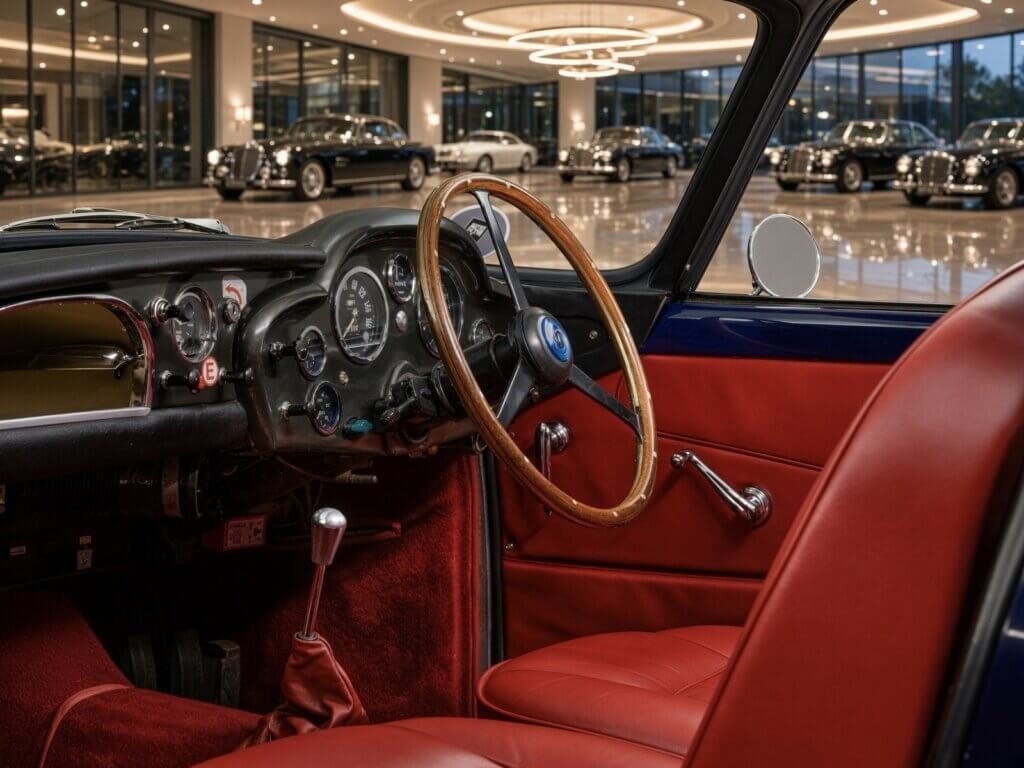
Lightweight DB4 GT
Among the most desirable DB4 GTs are the lightweight examples developed specifically for competition.
Aston Martin produced only a small number with further weight-saving measures, using lighter construction and removing equipment unnecessary for racing.
The factory identifies eight original lightweight DB4 GTs, most of which survive today.
These cars occupy a special position in Aston Martin history.
They represent the DB4 GT concept taken to its logical conclusion:
more power, less weight and maximum competition focus.
Their rarity and documented competition history make them among the most valuable DB4 GT derivatives.
The Birth of the DB4 GT Zagato
The DB4 GT provided the foundation for one of Aston Martin’s most celebrated designs: the DB4 GT Zagato.
In 1960 Aston Martin went further, commissioning Carrozzeria Zagato to create an even lighter and more compact body for the DB4 GT.
The resulting car was dramatically different.
Its body was smaller, more rounded and more sculptural, with an emphasis on weight reduction and aerodynamic efficiency.
The designer was the young Ercole Spada, who was only 23 when he created the body.
The original production plan called for 25 cars.
Only 19 were ultimately built.
The DB4 GT Zagato therefore became the ultimate expression of the concept that had begun with the DB4 GT:
take a beautiful grand tourer, remove unnecessary weight, increase performance and turn it into a true competition thoroughbred.
Production & Rarity
Aston Martin’s historical material records 75 Touring-bodied DB4 GTs, including the lightweight examples specifically created for racing.
A separate Aston Martin factory archive gives a broader production figure of 94 units, reflecting differences in how the model’s production is classified.
For collector purposes, the more useful figure is the number of original Touring-bodied production cars and, within that group, the extremely small number of factory lightweights.
This distinction is important.
Not every DB4 GT carries the same historical significance.
A car with original bodywork, matching-number mechanical components, documented ownership and period competition history will occupy a very different position in the market from a car that has been extensively reconstructed or converted.
What Makes the DB4 GT So Collectible?
The DB4 GT brings together almost every ingredient sought by the serious Aston Martin collector.
- Rarity
- Only a small number were produced.
- Provenance
- Individual chassis histories can include important owners, race drivers and competition events.
Engineering
The twin-plug straight-six and lightweight construction make the DB4 GT mechanically distinctive
Design
The combination of British engineering and Italian coachbuilding produced one of the most elegant GT shapes of its generation.
Competition
The car was conceived for GT racing rather than simply adapted for occasional track use.
Historical Importance
The DB4 GT directly influenced the development of the DB4 GT Zagato and helped establish the engineering philosophy that would ultimately lead towards the DB5 and later Aston Martin GTs.
The DB4 GT Today
The DB4 GT has become one of the most sought-after post-war Aston Martins.
Aston Martin itself describes the DB4 GT and DB4 GT Zagato as two of the most valuable and collectible cars in the company’s history.
The market is highly sensitive to provenance.
A beautifully restored car with documented originality can command a substantial premium, while an example with significant competition history can move into an entirely different category.
Factory lightweight specification is particularly important.
So too are matching numbers, original bodywork, documented ownership and period racing history.
2026 Collector Value
Indicative collector-market range: approximately $2.5 million–$5 million+
This should be presented on Monaco Classic Cars as an editorial market indication rather than a formal valuation.
Exceptional factory lightweight examples, significant competition cars and cars with extraordinary provenance can exceed the upper end of this range.
The market for these cars is thin, meaning individual transactions can vary dramatically.
Recent auction evidence also needs to be separated carefully between original DB4 GTs and later DB4 GT Continuation cars. For example, RM Sotheby’s 2026 Woodcote Park sale recorded a DB4 GT Continuation at £477,500; this should not be used as a valuation for an original 1959–1963 DB4 GT.
The Collector’s Verdict
The Aston Martin DB4 GT is one of the great British performance cars of the 1950s and early 1960s.
It possesses the beauty of a grand tourer, the mechanical sophistication of a competition car and the rarity expected of a truly significant collector automobile.
Its importance goes beyond its specification sheet.
The shortened chassis, Superleggera construction, twin-plug straight-six and racing pedigree represent a moment when Aston Martin was successfully combining British engineering with Italian design and craftsmanship.
For collectors, the DB4 GT offers something increasingly rare: authentic competition heritage wrapped in one of the most elegant shapes ever to emerge from Newport Pagnell.
Collector Appeal: Exceptional
Historical Significance: Exceptional
Design Significance: Exceptional
Racing Heritage: Outstanding
Rarity: Exceptional