Aston Martin DB4 GT
Available To Source

We discreetly source and place vehicles of this calibre for private clients.
Aston Martin DB4 GT
1959–1963 | 3.7-litre twin-plug straight-six | 302 bhp | 4-speed manual | approximately 75 Touring-bodied examples
The Aston Martin DB4 GT holds a distinguished place in the history of British grand touring cars. Conceived not as a faster DB4 but as a lighter, more focused competition machine, it paired the elegance of the original with performance and agility meant to challenge the best GT cars of its era.
Introduced at the London Motor Show in October 1959, it marked a decisive evolution of the DB4 formula. The chassis was shortened, the body made considerably lighter and the cabin reduced to two seats. Tadek Marek’s straight-six engine also received a more highly developed specification.
Visually, the car looked every inch a grand tourer, yet it had the character of a genuine racing machine. Described by its makers as equally at home on road and track, it proved its competition credentials almost immediately. Driven by Sir Stirling Moss, the prototype, DP199/1, won its GT class at Silverstone and set a new lap record.
Why Was the DB4 GT Designed?
Introduced in 1958, the DB4 established Aston Martin as a serious builder of high-performance grand tourers, thanks to its touring bodywork, advanced six-cylinder engine and strong performance. But international GT racing demanded more. As a sophisticated four-seater, its weight and size limited it against lighter, more focused rivals.
The answer was the DB4 GT. Rather than simply adding power, Aston Martin’s engineers returned to the basics of competition-car design, creating a car that was:
- Shorter and lighter
- More powerful
- Sharper to drive, and built to compete on a racing circuit
Design & Proportions
At first glance, the DB4 GT appears unmistakably related to the DB4. Look more closely however, and the differences become apparent.
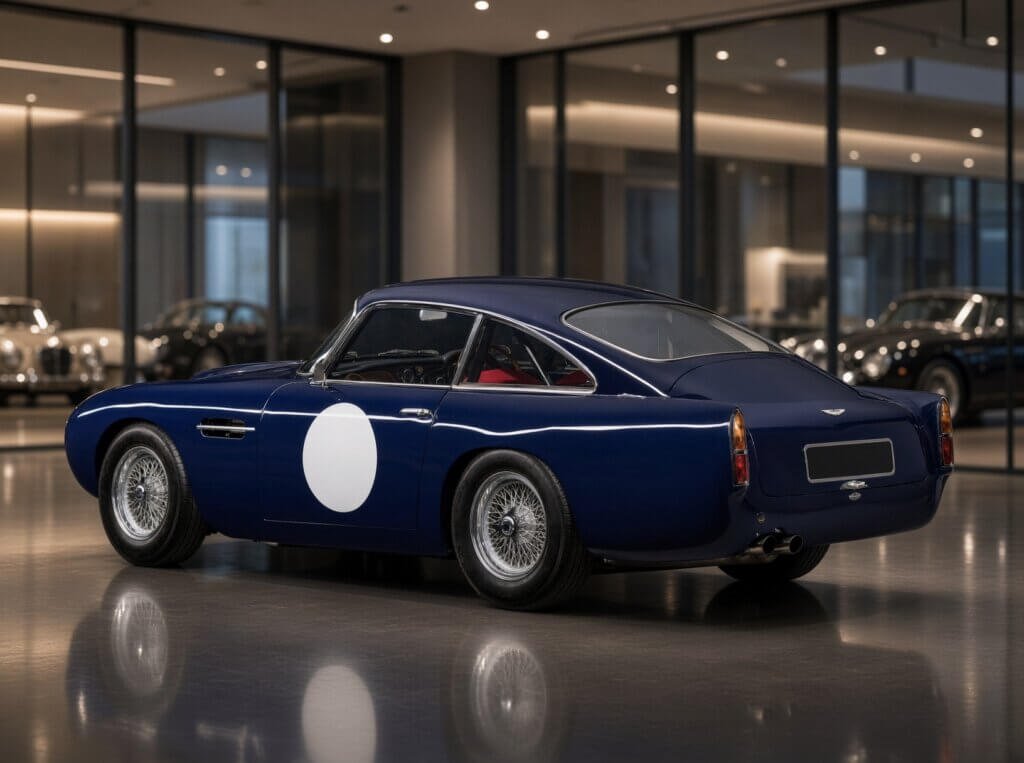
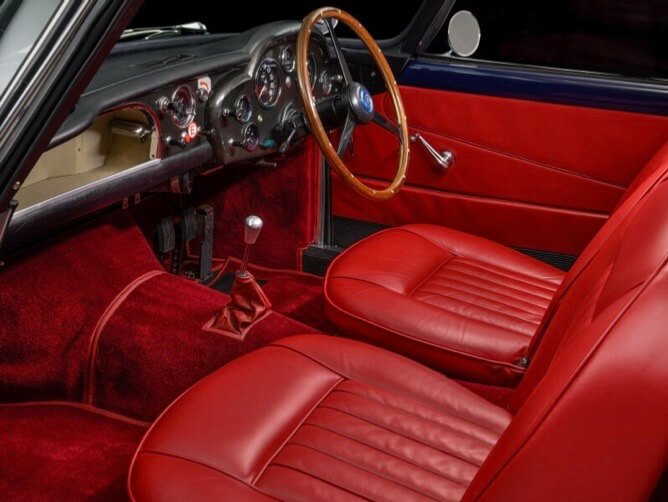
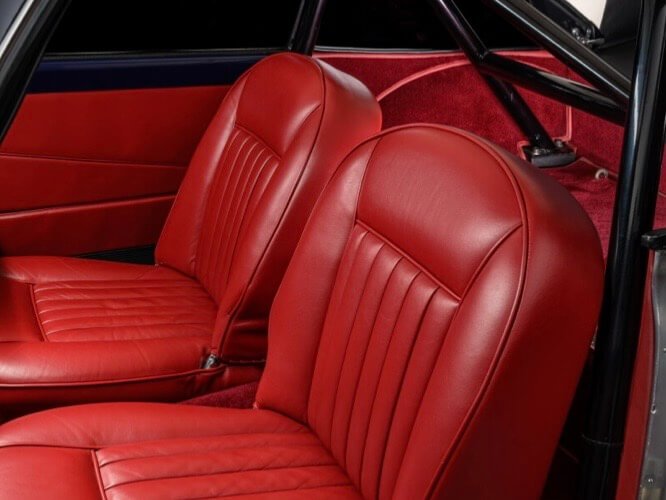
The wheelbase was shortened by five inches, reducing the distance between the axles, giving the car a more compact and purposeful stance. The body was also shorter and lighter, while the traditional four-seat configuration was replaced by a strict two-seat cabin.
The front of the car was particularly distinctive. Many examples featured faired-in headlamps, giving the DB4 GT a smoother and more aerodynamic appearance than the standard DB4.
The overall result was beautifully proportioned. The long bonnet remained, preserving the visual identity of the DB4. But the shorter cabin and rear bodywork gave the GT a considerably more sporting character.
This was not styling for styling’s sake. Every significant alteration served the same objective, reduce mass and improve performance.
Carrozzeria Touring & Superleggera Construction
The DB4’s elegant shape came from Carrozzeria Touring of Milan, whose influence was fundamental to the model’s identity. Touring’s famous Superleggera, or “super-light”, technique used thin aluminium panels formed over a lightweight tubular framework. As a result, the structure stayed strong while body weight fell, and the panels could be shaped into the flowing forms that became the family’s signature. The Newport Pagnell factory built the bodies under licence, using Touring’s principles and body jigs.
For the GT, however, the lightweight philosophy went considerably further. Thinner-gauge aluminium was used for the body, and the shortened chassis and reduced equipment added to the saving. According to the factory’s own records, the car was roughly 85 kg (about 185 lb) lighter than the standard model. This difference mattered, because in a competition car, removing weight is often more valuable than simply adding power.
The Shortened Chassis
- The DB4 GT’s wheelbase was reduced by five inches compared with the standard DB4.
- This seemingly modest alteration transformed the character of the car.
- A shorter wheelbase reduced the car’s polar moment of inertia and allowed it to change direction more readily.
- The two-seat configuration also contributed to its competition character.
- The car was no longer attempting to serve as a luxurious four-seat grand tourer first and sporting car second.
- The priorities had changed.
- The car was created with the circuit in mind.
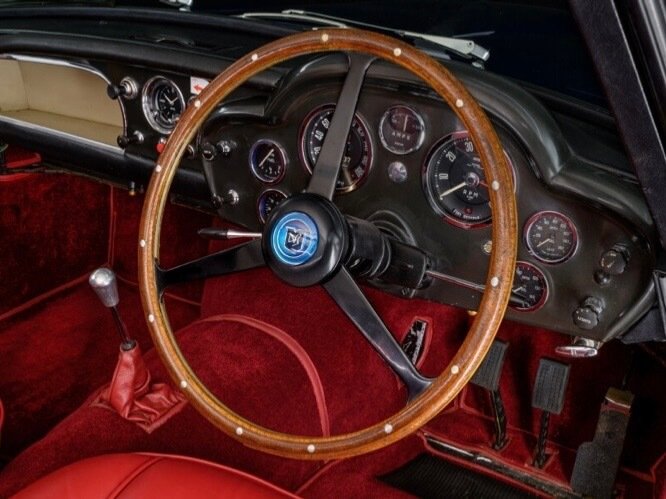
The Engine
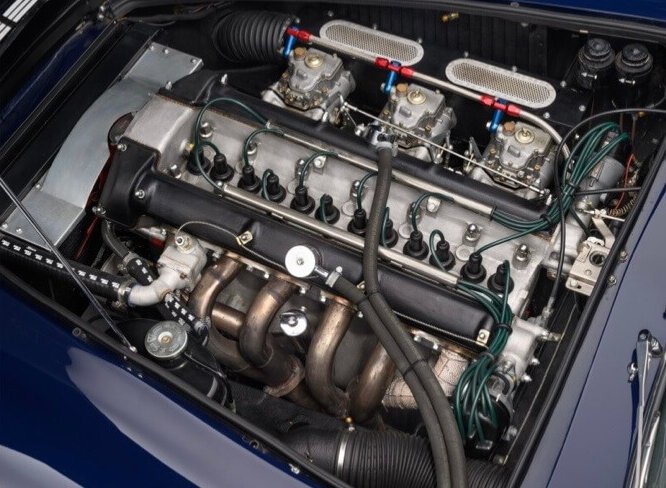
At the centre of the DB4 GT was Tadek Marek’s sophisticated 3.7-litre straight-six. The engine retained the fundamental architecture of the DB4 unit but received significant performance-oriented modifications.
One of the defining changes was the use of two spark plugs per cylinder, improving combustion efficiency and helping the engine produce its increased output. Triple Weber carburettors were employed, while the compression ratio was raised to 9:1.
The factory specification quoted approximately 302 bhp at 6,000 rpm, a remarkable figure for a 3.7-litre road-going engine of the period. The engine was paired with a four-speed manual transmission and drove the rear wheels.
Engine Specifications
Specification | Aston Martin DB4 GT |
Engine | Tadek Marek DOHC straight-six |
Displacement | 3,670 cc |
Cylinder head | Twin overhead camshafts |
Ignition | Twin spark plugs per cylinder |
Carburettors | Triple Weber |
Compression ratio | 9:1 |
Power | 302 bhp @ 6,000 rpm |
Torque | Approximately 240 lb-ft |
Transmission | 4-speed manual |
Drive | Rear-wheel drive |
Brakes | Girling servo-assisted discs |
Wheelbase | Shortened by 5 inches versus DB4 |
Weight | Approximately 1,269 kg |
0-60 mph | Approximately 6.1 seconds |
Top speed | Approximately 153-160 mph, depending on specification |
Aston Martin’s surviving factory documentation gives slightly different figures depending on the specification and source, particularly regarding weight and top speed. The figures above should therefore be regarded as period/factory specifications rather than modern independently measured performance figures.
DB4 GT Versus the Standard DB4
The difference between the two cars is much more profound than the name might suggest.
|
DB4 |
DB4 GT |
|
|
Engine |
3.7-litre straight-six |
3.7-litre twin-plug straight-six |
|
Power |
Approx. 240 bhp |
Approx. 302 bhp |
|
Seating |
Four |
Two |
|
Wheelbase |
Standard |
5 inches shorter |
|
Construction |
Superleggera |
Lightweight Superleggera |
|
Carburation |
Twin SU |
Triple Weber |
|
Brakes |
Disc brakes |
Four-wheel disc brakes |
|
Character |
Grand tourer |
The standard DB4 was designed to cover enormous distances at high speed in comfort.
The DB4 GT took that same philosophy and sharpened every element.
It was the DB4 stripped back to its sporting essentials.
Competition History
The competition career began almost immediately. Before the production model had even reached customers, the prototype DP199/1 showed its potential at Silverstone, where Sir Stirling Moss won the GT race and set a new lap record. This achievement was significant, because it proved the company had built something genuinely competitive rather than merely a more powerful luxury coupe.
Subsequently, the car became a favourite among privateer drivers. Its high-speed performance, compact dimensions and sophisticated chassis made it particularly effective in European GT competition. Moreover, it could be driven to the circuit, raced and driven home again, which is precisely the dual-purpose capability that defined the greatest GT cars of the era.
Finally, its racing success forged an important link between road-car and competition programmes. In effect, it served as a bridge between the elegant grand tourer that preceded it and the increasingly specialised racing machinery that followed.
Lightweight DB4 GT
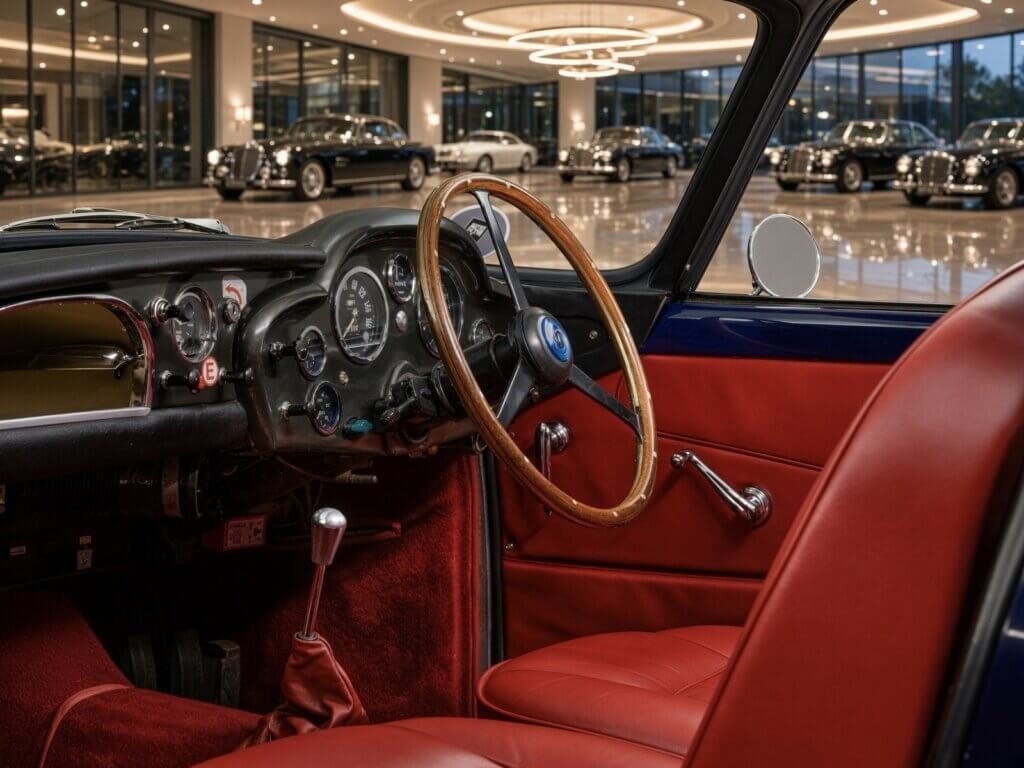
Among the most desirable DB4 GTs are the lightweight examples developed specifically for competition. Aston Martin produced only a small number with further weight-saving measures, using lighter construction and removing equipment unnecessary for racing.
The factory identifies eight original lightweight DB4 GTs, most of which survive today. These cars occupy a special position in Aston Martin history. They represent the DB4 GT concept taken to its logical conclusion, more power, less weight and maximum competition focus.
Their rarity and documented competition history make them among the most valuable DB4 GT derivatives.
The Birth of the DB4 GT Zagato
The Zagato Evolution
The GT laid the foundation for one of the marque’s most celebrated designs: the DB4 GT Zagato. In 1960, the company went further by commissioning Carrozzeria Zagato to build an even lighter, more compact body.
The result was dramatically different. The body was smaller, more rounded and more sculptural, with a clear emphasis on weight reduction and aerodynamic efficiency. Moreover, it was shaped by Ercole Spada, who was only 23 at the time. Although the original plan called for 25 cars, only 19 were ultimately built.
Consequently, the Zagato became the ultimate expression of the concept that began with the GT: take a beautiful grand tourer, remove unnecessary weight, increase performance and turn it into a true competition thoroughbred.
Production & Rarity
Aston Martin’s historical material records 75 Touring-bodied DB4 GTs, including the lightweight examples specifically created for racing.
A separate Aston Martin factory archive gives a broader production figure of 94 units, reflecting differences in how the model’s production is classified. For collector purposes, the more useful figure is the number of original Touring-bodied production cars. And, within that group, the extremely small number of factory lightweights.
This distinction is important. Not every DB4 GT carries the same historical significance.
A car with original bodywork, matching-number mechanical components, documented ownership and period competition history will occupy a very different position in the market from a car that has been extensively reconstructed or converted.
What Makes the DB4 GT So Collectible?
Collector Appeal
The GT brings together almost every ingredient the serious collector looks for.
- Rarity: Only a small number were produced.
- Provenance: Individual chassis histories can include notable owners, race drivers and competition events.
- Engineering: The twin-plug straight-six and lightweight construction make it mechanically distinctive.
- Design: British engineering combined with Italian coachbuilding produced one of the most elegant GT shapes of its generation.
- Competition: It was conceived for GT racing, not simply adapted for occasional track use.
- Historical importance: It directly influenced the Zagato version and helped establish the engineering philosophy that led towards the DB5 and the grand tourers that followed.
The DB4 GT Today
Market Value
The GT has become one of the most sought-after post-war British sports cars, and the factory itself counts it, together with the Zagato version, among the most valuable and collectible cars in its history. Moreover, the market is highly sensitive to provenance. A beautifully restored car with documented originality can command a substantial premium, while one with a significant competition history can move into an entirely different category.
Factory lightweight specification is particularly important. Likewise, buyers prize matching numbers, original bodywork, documented ownership and period racing history.
2026 Collector Value
Indicative collector-market range: approximately $2.5 million–$5 million+. Exceptional factory lightweight examples, significant competition cars and cars with extraordinary provenance can exceed the upper end of this range.
The market for these cars is thin, meaning individual transactions can vary dramatically. Recent auction evidence also needs to be separated carefully between original DB4 GTs and later DB4 GT Continuation cars.
For example, RM Sotheby’s 2026 sale recorded a DB4 GT Continuation at £477,500; this should not be used as a valuation for an original 1959–1963 DB4 GT.
The Collector’s Verdict
The Aston Martin DB4 GT is one of the great British performance cars of the 1950s and early 1960s.
It possesses the beauty of a grand tourer, the mechanical sophistication of a competition car and the rarity expected of a truly significant collector automobile. Its importance goes beyond its specification sheet.
The shortened chassis, Superleggera construction, twin-plug straight-six and racing pedigree represent a moment when Aston Martin was successfully combining British engineering with Italian design and craftsmanship.
For collectors, the DB4 GT offers something increasingly rare. Authentic competition heritage wrapped in one of the most elegant shapes ever to emerge from Newport Pagnell.
Collector Appeal: Exceptional. Historical Significance: Exceptional. Design Significance: Exceptional
Racing Heritage: Outstanding
Rarity: Exceptional


Location UK
We discreetly source and place vehicles of the calibre for private clients.
This page is for general information only and is not financial advice. Values vary widely by chassis, history and condition.