McLaren F1
Available to Source
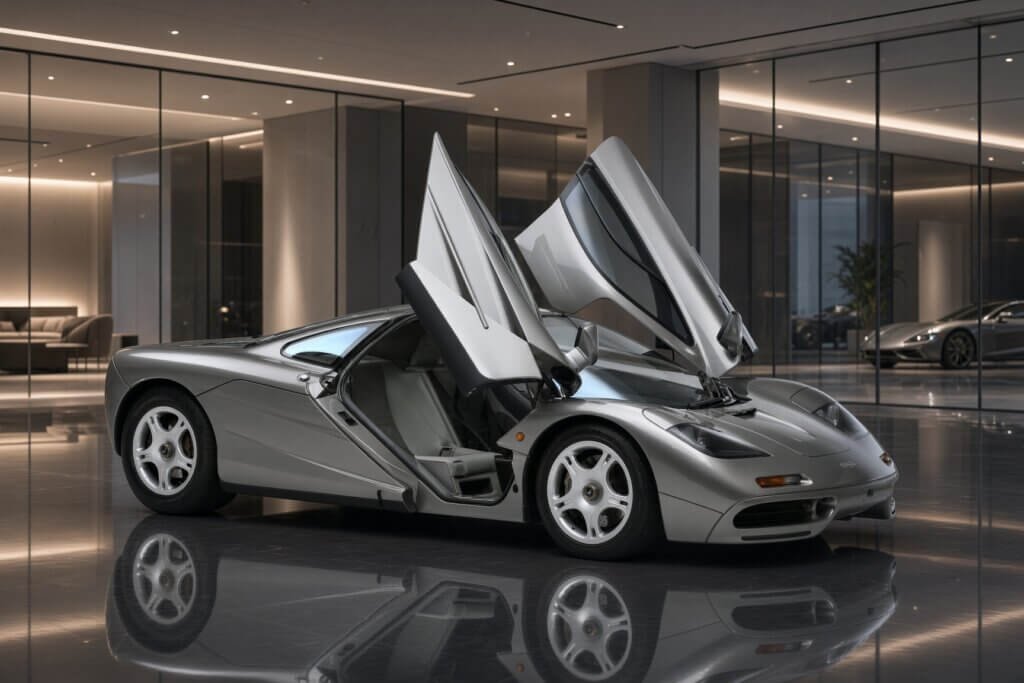
We discreetly source and place vehicles of this calibre for private clients.
McLaren F1
1992-1998 | 6.1-litre BMW V12 | 627 bhp | 106 cars across road and racing variants
Few cars can legitimately be described as engineering landmarks, yet the McLaren F1 belongs firmly in that small and distinguished company. Conceived by Gordon Murray and built by McLaren as the ultimate road car. It rejected turbocharging, four-wheel drive, electronic driver aids and automatic transmissions altogether.
Lightness, mechanical purity and driver involvement took priority, with a naturally aspirated BMW V12 sitting behind a driver seated in the middle of the car. The result was more than one of the fastest cars of its generation, because it became the benchmark for an uncompromising road car.
Origins and Philosophy
The F1 began in 1988, when Gordon Murray, already one of Formula 1’s most respected engineers, started to develop a wholly new kind of road car. McLaren wanted what Murray regarded as the ultimate road-going automobile. Built around minimal weight, maximum performance and complete driver focus.
Because the project was free of the demands of a large production programme, engineers could pursue solutions that would have been impractical for a conventional supercar. Weight became the central obsession, since a lighter car needs less power and smaller brakes, generates less inertia and changes direction more quickly. Speed was therefore achieved through fundamental engineering rather than ever more sophisticated electronics.
The Central Driving Position
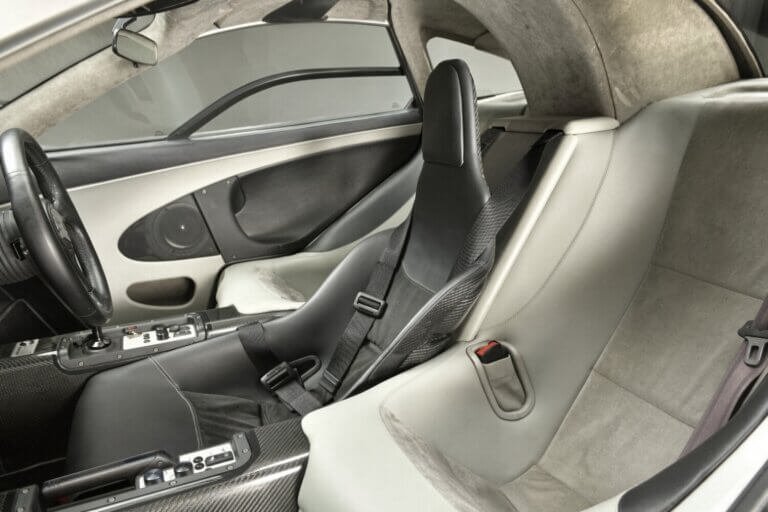
The driver sits in the middle of the cockpit, with a passenger seat set slightly behind and to either side. This was no styling gesture, because the central position gives a symmetrical view of the road and makes the width of the car easier to judge. It also makes the driver the focal point of the machine, while still allowing the F1 to carry three people as a grand tourer.

Design and Construction
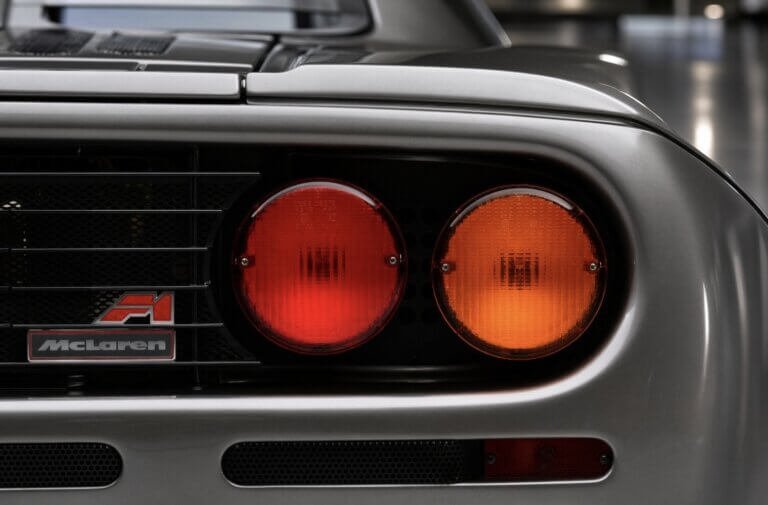
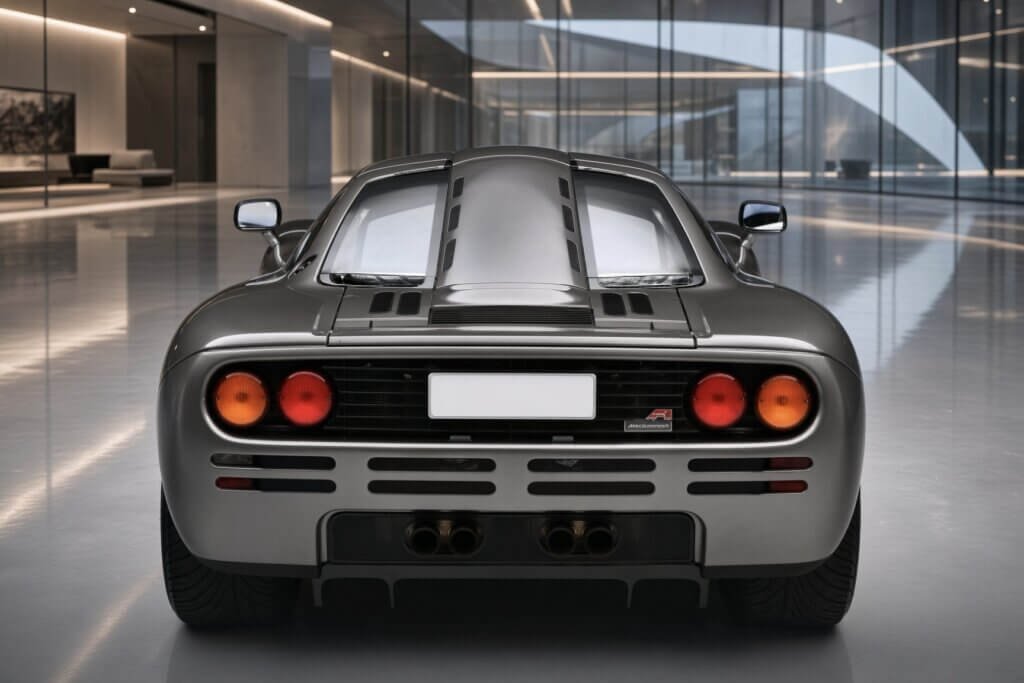
British designer Peter Stevens translated Murray’s engineering requirements into bodywork that is elegant rather than aggressive. Even today, the standard road car has no large wings, no superfluous vents and no exaggerated styling features. Its low, narrow proportions were dictated by airflow, cooling and high-speed stability, which is why the shape still looks purposeful more than three decades later.
The greatest engineering achievement lay beneath the bodywork, where McLaren built the central monocoque from carbon-fibre composite at a time when the material was rare in road cars. Exceptional rigidity was achieved without unnecessary mass and the structure allowed the suspension and powertrain to be integrated into an unusually compact package.
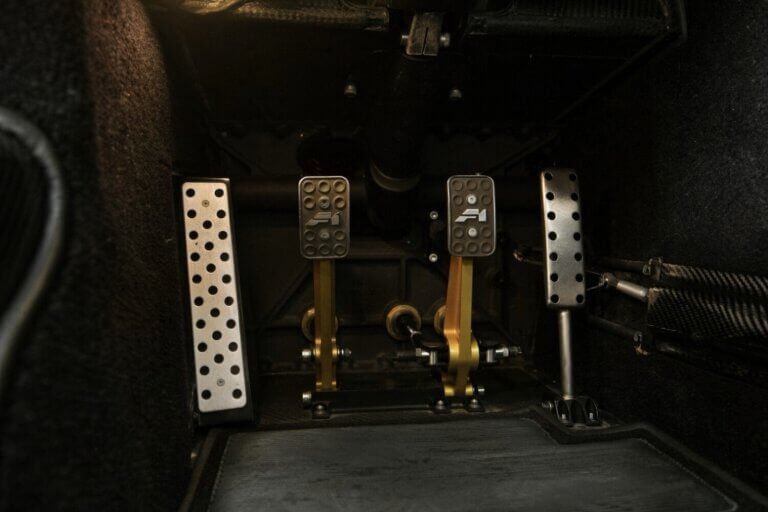
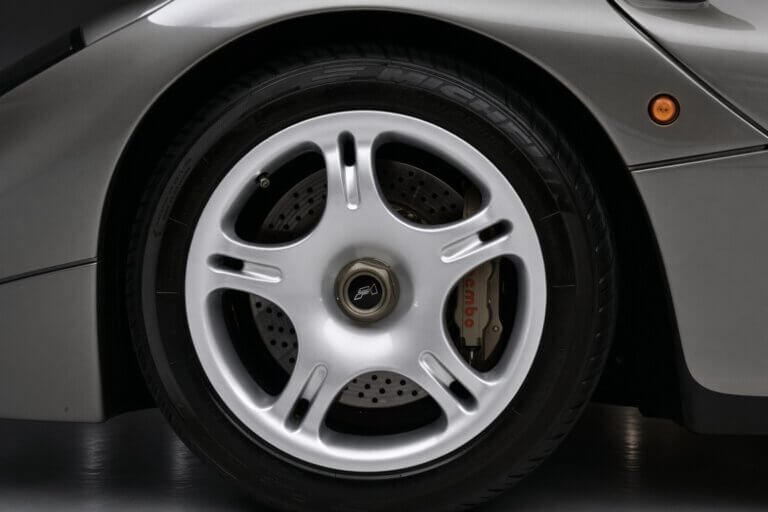
Carbon fibre was therefore fundamental to the architecture, rather than a later addition to a conventional steel or aluminium sports car. Every component was judged by its contribution to weight and performance, so the steering had no power assistance, the brakes had no ABS and the manual gearbox was compact and direct.












The BMW V12
After considering several options, McLaren turned to BMW Motorsport and the engine specialist Paul Rosche, who developed the 6.1-litre S70/2 V12 specifically for the F1. Compact and relatively light for its capacity, the engine produced approximately 627 bhp at 7,400 rpm and around 650 Nm (480 lb-ft) of torque without any form of forced induction. With no turbocharger to blunt throttle response and no hybrid assistance, power reached the rear wheels through a direct six-speed manual gearbox.
| Specification | McLaren F1 |
|---|---|
| Engine | BMW S70/2, 60-degree V12, 6,064 cc |
| Valvetrain | DOHC, four valves per cylinder, individual throttle bodies |
| Power | 627 bhp at 7,400 rpm |
| Torque | Approx. 650 Nm (480 lb-ft) |
| Transmission and drive | Six-speed manual, rear-wheel drive |
| Chassis | Carbon-fibre monocoque |
| Suspension and steering | Independent double wishbone; unassisted rack-and-pinion |
| Brakes | Carbon-composite ventilated discs |
| Weight | Approx. 1,140 kg |
| Power-to-weight | Approx. 550 bhp per tonne |
| Top speed | Approx. 240 mph in record-setting configuration |
Combined with a kerb weight of roughly 1.1 tonnes, that output gave about 550 bhp per tonne. It was this low mass, rather than the headline horsepower, that defined the character of the car.
Gold in the Engine Bay
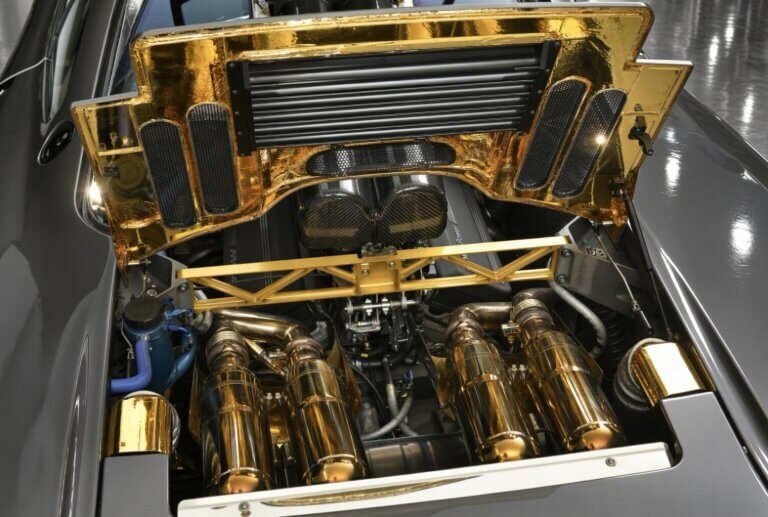
The engine bay was lined with gold foil, which was chosen for its excellent heat-reflective properties rather than for theatre. Because the V12 generated considerable heat, the foil protected the surrounding carbon-fibre structure and other components, a neat example of engineering purpose behind an extravagant material.
Aerodynamics and Performance
Instead of large external wings, McLaren concentrated on managing airflow beneath and around the car, giving it stability without compromising its clean lines. As a result, the road car looks restrained beside many later hypercars, because its aerodynamics were built into the architecture rather than attached afterwards.
In 1998 a McLaren F1 recorded a top speed of approximately 240.1 mph, although this was achieved with the rev limiter removed and in a specific high-speed configuration. Strong torque from the naturally aspirated engine, low weight and a manual gearbox also delivered acceleration that stayed competitive with much newer supercars for decades.

Interior and Grand Touring Ability
The cabin is unlike almost anything else in the supercar world, with a wraparound dashboard centred on the driver and passenger seats positioned behind and slightly outward. Leather, carbon fibre, aluminium and carefully engineered controls create an environment closer to a bespoke aircraft cockpit than to a conventional luxury car. Murray also intended the F1 to cover long distances, so luggage compartments sit ahead of and behind the passenger area, allowing genuine grand touring. Excellent visibility, a refined engine and a firm but usable suspension allowed the car to be devastatingly fast without becoming a single-purpose machine.
Racing and the 1995 Le Mans Victory
The road car’s architecture formed the basis of the F1 GTR, which McLaren developed for international GT racing. Its greatest moment came at the 1995 24 Hours of Le Mans, where the production-derived car defeated purpose-built prototypes to take overall victory and four of the top five places. That success validated Murray’s original philosophy, proving that a lightweight carbon structure, careful aerodynamics and a BMW V12 could compete at the highest level of endurance racing.
Production and Rarity
McLaren built just 106 F1s between 1992 and 1998 across all road and racing variants, of which approximately 64 were standard road cars. The remainder comprised competition and special derivatives, including the F1 GTR, F1 LM and F1 GT, so each chassis has an individual identity. Created to mark the Le Mans win, the F1 LM was lighter, more aerodynamic and fitted with a competition-developed engine, and only five were built. Developed from the GTR to meet homologation requirements, the long-tailed F1 GT was produced in just three examples, including the prototype.
The F1 Today
Today the F1 is a major collector asset, valued not only for its performance but for a moment when an independent manufacturer pursued almost limitless technical ambition. Its formula grows more distinctive with age, combining a naturally aspirated V12, manual gearbox, rear-wheel drive, carbon-fibre monocoque, central driving position and minimal electronic intervention.
The 2026 Collector Market
No single value applies to every F1, since road cars, LMs, GTs and GTRs each occupy a different market. As an editorial guide rather than a formal valuation, exceptional original road cars might be positioned at roughly $20 million to $30 million or more in 2026. A 1995 car sold for $20,465,000 at Gooding & Company in 2021, and a 1994 road car, the 14th of 64, reached $25,317,500 at RM Sotheby’s in Abu Dhabi in December 2025. In August 2026 the 1996 F1 GTR known as the “Pop Art F1”, chassis 10R, achieved $34,655,000 at RM Sotheby’s Monterey, though that competition result should not be used to value a standard road car.
Provenance is what separates one F1 from another. Chassis number, specification, originality, mileage, service history, competition record, factory upgrades and ownership history can each shift a price dramatically, so the real question is always which F1 it is.
Legacy
The F1 changed how engineers thought about the road-going supercar, showing that extreme performance does not require huge displacement, turbochargers, four-wheel drive or electronic intervention. Its influence continues in Gordon Murray’s later work, most notably the T.50. Successors may be faster, accelerate harder and carry far more technology, yet the F1 remains in a category of its own, representing perfection pursued without today’s electronic safety net.
The Collector’s Verdict
Gordon Murray’s central-seat philosophy, Peter Stevens’s restrained design, McLaren’s carbon-fibre expertise and BMW’s V12 combined to create something that has never been truly replicated. Racing immortality came from Le Mans, rarity from a tiny production run and enduring desirability from its uncompromising character. For the serious collector, the F1 remains one of the ultimate acquisitions in automotive history.

Location Europe
We discreetly source and place vehicles of this calibre for private clients.
This page is for general information only and is not financial advice. Values vary widely by chassis, history and condition.