Mercedes-Benz 300 SL Gullwing
Available To Source

We discreetly source and place vehicles of this calibre for private clients.
The Birth of the Modern Supercar
1954–1957 | 3.0-litre Straight-Six | Bosch Mechanical Fuel Injection | Up to 215–220 bhp | 1,400 Coupés Produced
An Icon of Engineering and Design
Few automobiles have achieved the enduring distinction of the Mercedes-Benz 300 SL Gullwing. With its sculptural bodywork, extraordinary roof-hinged doors and racing-derived engineering, it established a new benchmark for the high-performance production car.
Introduced in 1954, the Gullwing was the road-going expression of Mercedes-Benz’s successful 300 SL racing programme. It brought the company’s competition experience to a select international clientele. Combining exceptional speed with technical innovation and a level of craftsmanship that reflected the marque’s engineering ambitions.
Its significance extended well beyond its appearance. The 300 SL introduced mechanical direct petrol injection to a four-stroke production passenger car. Employed an innovative tubular spaceframe chassis and offered performance that placed it among the fastest road cars of its generation.
More than seventy years later, the Gullwing remains one of the defining automobiles of the twentieth century. A machine in which engineering necessity created one of the most recognisable designs in motoring history.
The Origins — From Racing Circuit to Open Road
The story of the 300 SL began with the Mercedes-Benz W 194 competition car of 1952.
Returning to international motorsport after the Second World War. Mercedes-Benz developed a lightweight sports-racing machine capable of competing at the highest level. The W 194 achieved notable success in events, including the 24 Hours of Le Mans and the Carrera Panamericana. Establishing the foundations for a new generation of high-performance Mercedes-Benz automobiles.
The racing car’s most significant feature was its tubular spaceframe chassis. Constructed from a network of lightweight steel tubes, the frame provided exceptional rigidity for its weight.
However, its tall side structures created a practical challenge. Conventional doors could not be fitted without compromising the chassis architecture.
The solution was to hinge the doors at roof level. When Mercedes-Benz decided to create a production version for the American market, this engineering necessity became the feature that would define the car forever.
The production 300 SL was unveiled at the International Motor Sports Show in New York in February 1954.
It was a remarkable transition from racing machinery, to a road-going grand-tourer, retaining the spirit of the competition car. While introducing greater refinement, comfort and usability.
The Design | Form Follows Engineering
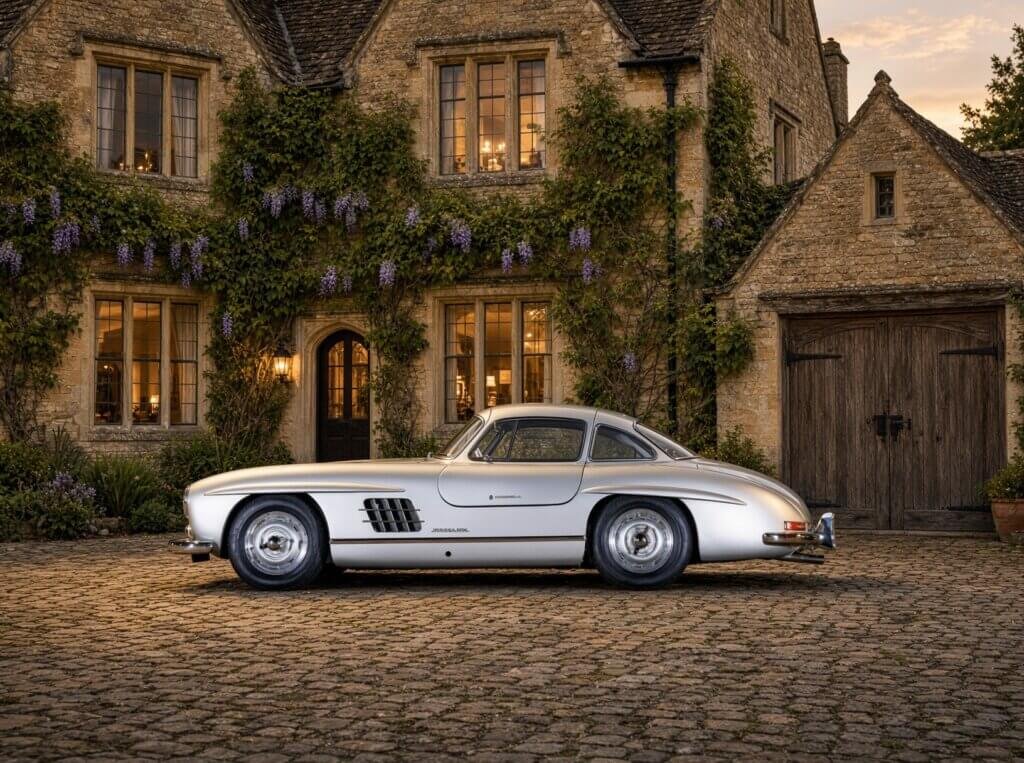
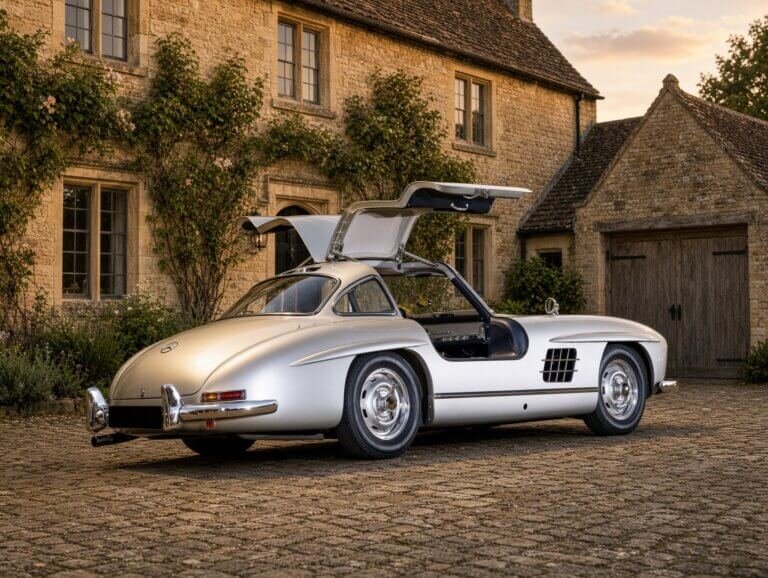
The Gullwing’s appearance is inseparable from its mechanical architecture. Its long bonnet, low nose, compact passenger compartment and tapered rear bodywork created an elegant, aerodynamic silhouette. Beneath the beautifully proportioned exterior lay a chassis designed around strength, low weight and high-speed stability.
The bodywork was formed from steel, with aluminium used for selected panels. The car’s structure, rather than the body panels themselves, provided its fundamental rigidity.
The tubular spaceframe was the real engineering achievement. Because the chassis carried the major structural loads, the exterior body could be shaped around aerodynamic and aesthetic objectives. Without serving as the principal load-bearing structure.
The result was a car with unusual proportions and a distinctive relationship between its body and chassis. The bonnet extended over a substantial front-mounted engine. While the roofline flowed into a compact rear section. Subtle air outlets in the front wings helped manage under-bonnet airflow, and the restrained chrome detailing provided a sophisticated contrast to the sculpted body.
The Gullwing looked futuristic in the 1950s. Today, its design remains remarkably contemporary.
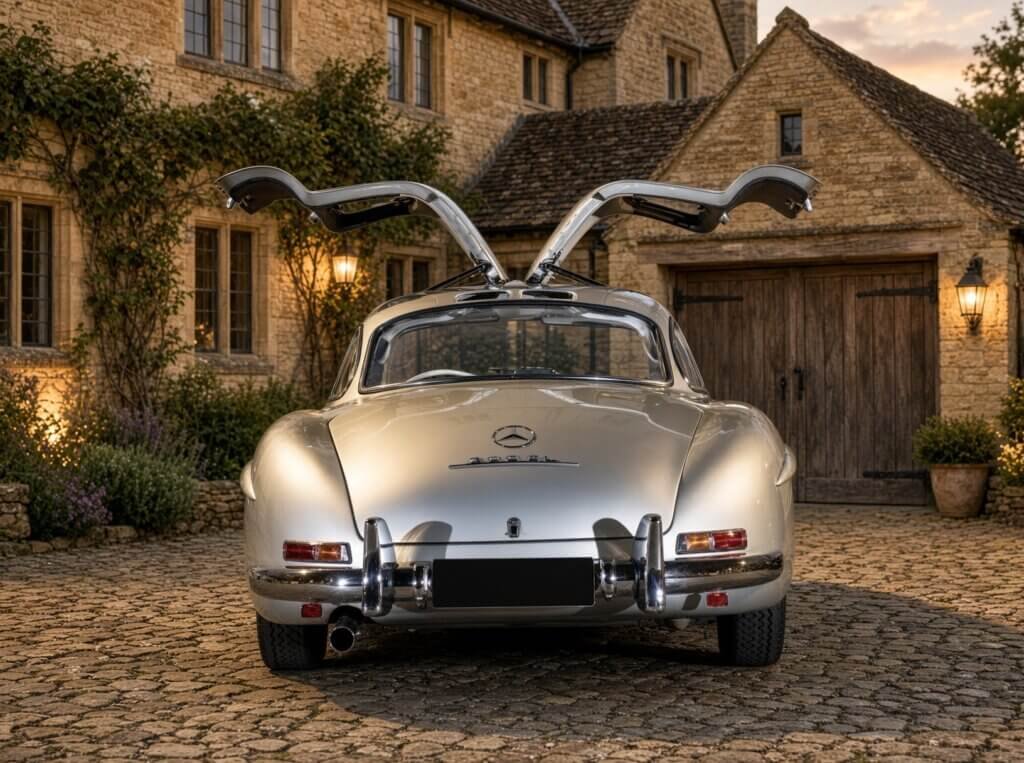
The Gullwing Doors | An Engineering Signature
The doors are the defining visual feature, but their origins were practical rather than theatrical. The tubular spaceframe’s high side members made conventional side doors impractical. Mercedes-Benz therefore adopted roof-hinged doors that opened upwards. Allowing occupants to enter and leave the car despite the deep structural sills.
The doors created an unmistakable silhouette when raised. They also made the car more challenging to enter and exit than a conventional coupé, particularly because the steering wheel and high sill could restrict movement. The steering wheel could be tilted to improve access.
Inside, the cabin reflected the same balance of engineering and luxury as the exterior. Carefully shaped seats, an elegant instrument panel, fine materials and generous period detailing. Created a sophisticated environment for high-speed touring.
The Gullwing’s doors became one of the most enduring automotive design signatures ever conceived. A reminder that some of the most celebrated styling features begin as solutions to engineering problems.


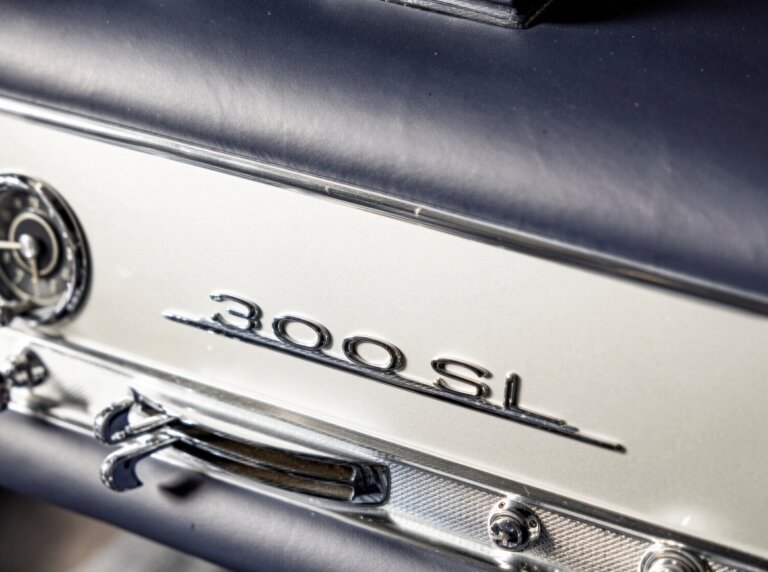




The Tubular Spaceframe | Lightweight Strength
At the heart of the 300 SL was its innovative tubular steel spaceframe. Unlike a conventional body-on-frame construction, the spaceframe used a network of triangulated tubes. To create a rigid structure around the passenger compartment.
This approach offered an exceptional strength-to-weight balance, but it came with a compromise. The deep side structures prevented the use of ordinary doors.
The chassis was therefore fundamental to both the car’s performance and its identity. Its rigidity supported precise suspension geometry. While the lightweight construction, helped the Gullwing achieve remarkable performance from a three-litre engine.
The engineering philosophy was characteristic of Mercedes-Benz at the time. Solve the fundamental technical problem first, then develop the complete automobile around that solution.
Engine & Mechanical Specification
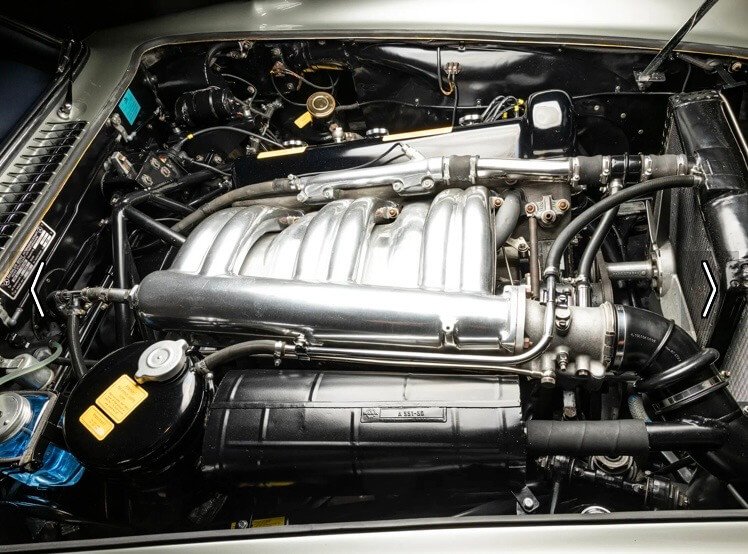
The 300 SL’s engine was as significant as its bodywork. Its 2,996 cc overhead-camshaft inline-six was derived from the company’s larger production-engine family. But extensively developed for the sports car. The most important innovation was Bosch mechanical direct petrol injection. Which delivered fuel directly into the combustion chambers rather than through conventional carburettors.
This was a major technological advance for a production passenger car. Direct injection helped increase power and improve the engine’s performance characteristics. Enabling the Gullwing to deliver remarkable speed without resorting to a larger displacement or forced induction.
The engine was also installed at an angle to lower the bonnet line, helping preserve the car’s low, streamlined profile.
Factory Engine Specification
Specification | Mercedes-Benz 300 SL Gullwing |
Model designation | W 198 |
Engine | M 198 inline-six |
Capacity | 2,996 cc |
Valvetrain | Single overhead camshaft |
Induction | Bosch mechanical direct petrol injection |
Maximum power | Approximately 215 – 220 bhp |
Transmission | 4-speed manual |
Drive | Rear-wheel drive |
Chassis | Tubular steel spaceframe |
Front suspension | Independent double wishbones and coil springs |
Rear suspension | Single-joint swing axle |
Brakes | Hydraulic drum brakes on all four wheels |
Top speed | Approximately 135 – 160 mph, depending on specification |
Factory and auction-house literature sometimes quotes different power figures, reflecting specification and measurement conventions. Top speed also varied with rear-axle ratio and equipment. The Gullwing’s headline performance figures should therefore be read in context rather than as a single universal specification.
Performance | A New Standard for the Era
The 300 SL was among the fastest production road cars of its time. Its combination of a lightweight spaceframe, aerodynamic body. And direct-injection straight-six enabled exceptional high-speed performance. With the appropriate rear-axle ratio, the car could approach 160 mph. An extraordinary achievement for a production automobile in the mid-1950s.
Yet the Gullwing was not designed exclusively for outright speed. It was also intended to cover long distances at sustained pace. With a comfortable cabin and the mechanical refinement expected of a prestigious Mercedes-Benz.
The result was a car that combined sporting ability with genuine grand-touring character. Its achievement was not simply that it could travel quickly. It was that it could do so with sophistication.
Chassis, Suspension & Braking
The Gullwing’s chassis was complemented by an advanced suspension layout for its period. At the front, independent double-wishbone suspension with coil springs provided controlled wheel movement and precise handling. At the rear, Mercedes-Benz employed a single-joint swing-axle design, which required careful attention to suspension geometry and driving technique.
The original Gullwing used hydraulic drum brakes on all four wheels. Although powerful for their time, they lacked the sustained heat-dissipation capability of later disc-brake systems. This distinction is important when evaluating the car’s original engineering.
The 300 SL was a sophisticated 1950s sports car, but it should be understood in the context of the technology available when it was designed. Its historical importance lies in how effectively Mercedes-Benz combined the technologies of its day, into a coherent, high-performance automobile.
Production and Rarity
The 300 SL Coupé was built from 1954 to 1957. Mercedes-Benz produced just 1,400 Gullwings for an exclusive international clientele. Most cars had steel bodies. Twenty-nine had lighter aluminium panels, making them especially rare and desirable.
Competition Heritage
The W 194 racing car proved the spaceframe concept and established the 300 SL name. The Gullwing adapted that engineering for the road.
Private entrants also raced 300 SLs, including a class victory in the 1955 Mille Miglia.
Why Collectors Want It
- Design: Roof-hinged doors and a low roofline create an unmistakable silhouette.
- Engineering: The tubular spaceframe and mechanical direct injection were major achievements.
- Global appeal: European, American and Asian collectors all pursue it.
- Driving experience: Its mechanical character cannot be matched by a modern sports car.
What Determines Value
Condition matters, but it is only part of the picture. Two equally polished cars can differ greatly in value.
- Aluminium bodywork: These cars may command substantial premiums.
- Matching numbers: Chassis, engine, gearbox and factory records should align.
- Documentation: Build record, data card, ownership history and restoration invoices all count.
- Originality: Correct paint, trim, interior, wheels, luggage and tools strengthen appeal.
- Restoration quality: Recognised specialists and detailed records build confidence.
- Specification: Rudge centre-lock wheels, the NSL engine and rare colour combinations add value.
- Provenance: Notable owners and competition history set cars apart.
A documented specialist restoration can make a car exceptional. A well-preserved original can be equally desirable.
Collector Values
The Gullwing sits in the upper tier of the classic-car market.
Indicative range: about US$1.3–2.2 million for many desirable steel-bodied cars. Exceptional cars can fetch substantially more. This is an editorial guide, not a formal appraisal.
Recent Gooding & Company auction results:
- 1955, Amelia Island, March 2025: US$1,501,000. Original engine and award-winning restoration.
- 1956, Pebble Beach, August 2025: US$1,572,500. Long single ownership and unrestored patina.
- 1957, Amelia Island, March 2026: US$2,012,500. Late-production car with a high-quality restoration.
- 1955, Pebble Beach, August 2026: US$2,975,000. This shows the premium for a standout car, not typical values.
Legacy and Verdict
The Gullwing helped set the template for the modern supercar. It was ambitious, dramatic and fast, yet refined.
The finest examples combine strong documentation, outstanding preservation or restoration, and a clear history. The aluminium cars are the rarest chapter.
A racing-bred machine and a technological pioneer. One of the great collector automobiles of all time.

Location Europe
We discreetly source and place vehicles of this calibre for private clients.
This page is for general information only and is not financial advice. Values vary widely by chassis, history and condition.