Porsche Carrera GT (2004)
Available To Source

We discreetly source and place vehicles of this calibre for private clients.
Porsche Carrera GT (2004)
The Last Great Analogue Supercar
A Masterpiece of Pure Driving Emotion
Unfiltered Performance, Unmistakable Character
Some supercars are remembered for their speed, others become icons through their design or engineering. The Porsche Carrera GT commands respect for something increasingly rare: the purity of its driving experience.
Unveiled as a near-production concept at the Paris Motor Show in 2000, the Carrera GT brought racing-inspired technology to the road in a form that was both breathtakingly beautiful and uncompromisingly purposeful. Its carbon-fibre construction, naturally aspirated V10 engine and six-speed manual transmission created a supercar defined by direct mechanical connection rather than electronic intervention.
Produced between 2003 and 2006, the Carrera GT represented a remarkable chapter in Porsche’s history. It was developed with the spirit of endurance racing at its heart, yet refined into a road-going machine capable of extraordinary performance.
Today, the Carrera GT is widely regarded as one of the defining analogue supercars of its generation — a rare combination of engineering ambition, sensory drama and timeless design.
Design & Aerodynamics — Sculpted for Speed
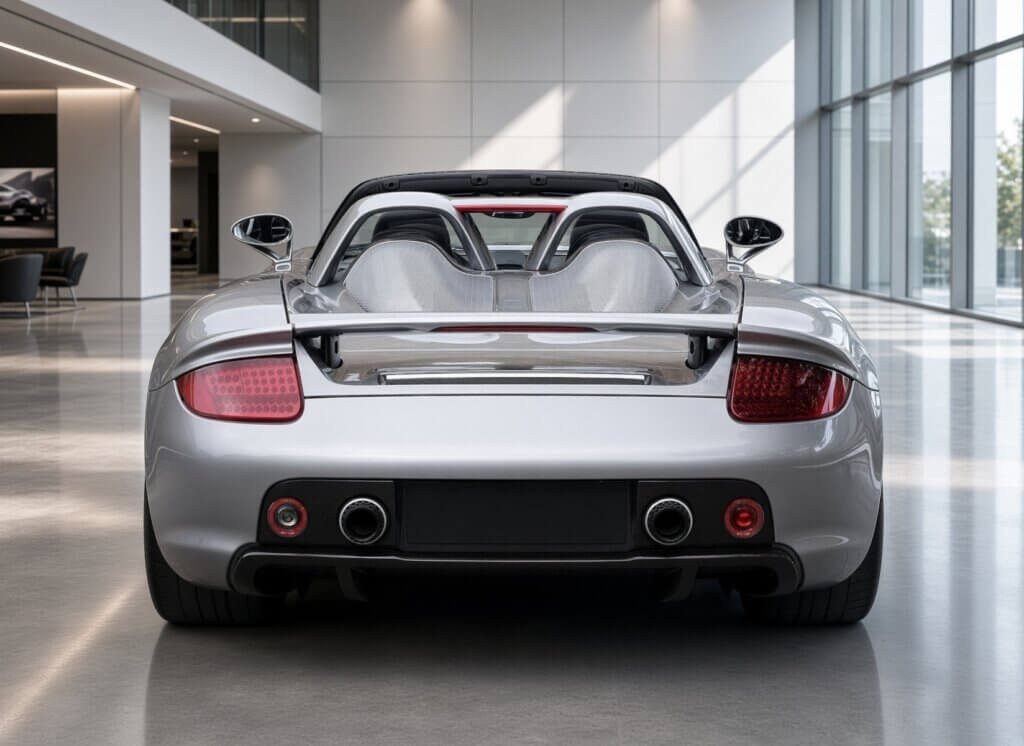
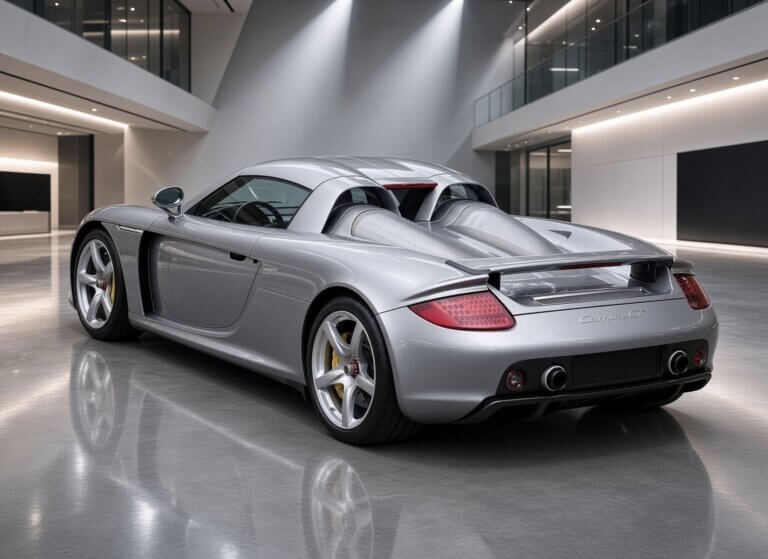
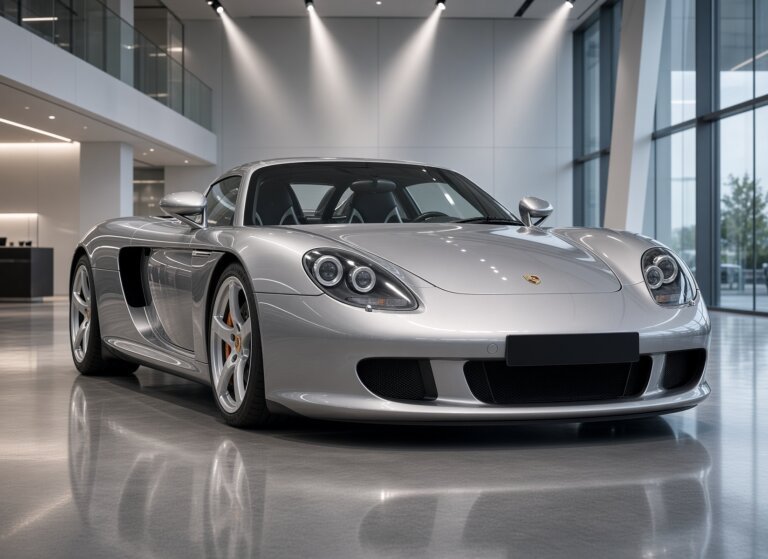
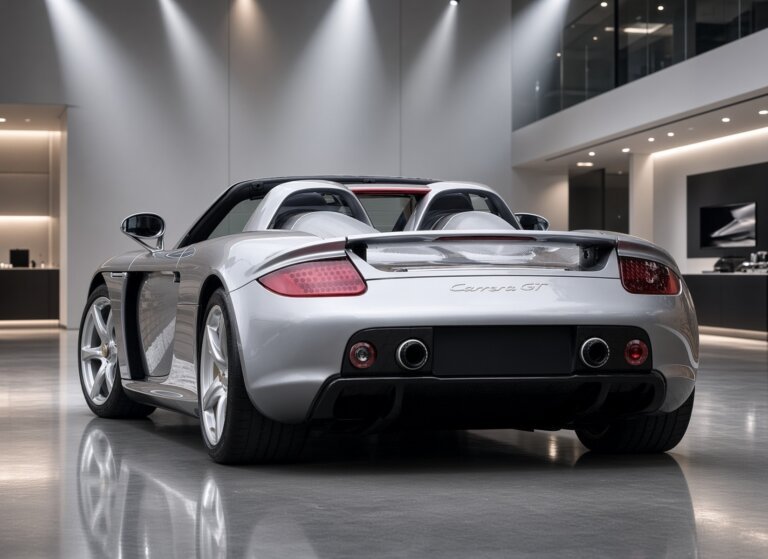
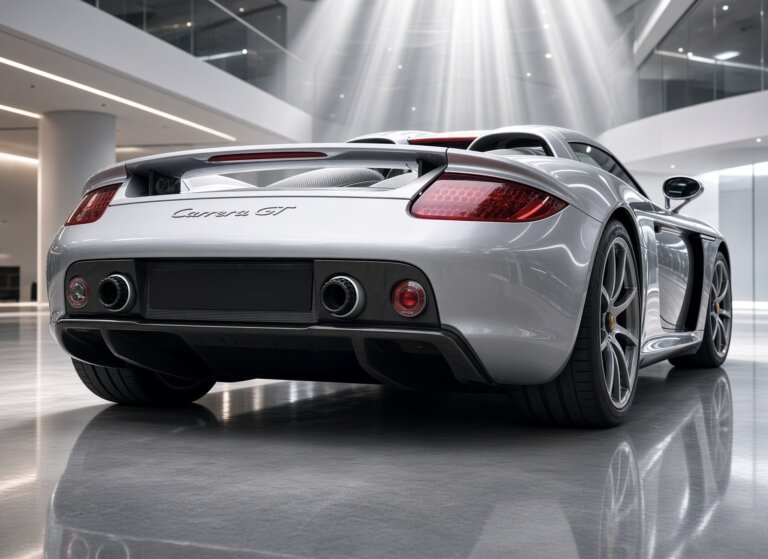
The Carrera GT’s design combines flowing bodywork with the unmistakable technical presence of a competition car. Its low nose, pronounced front wheel arches, compact cabin and broad rear haunches create a stance that communicates performance from every angle.
Designed under Porsche’s internal styling programme, with exterior design led by Tony Hatter, the body was shaped around the demands of cooling, aerodynamic stability and lightweight construction. The result is purposeful without being excessive, with every major surface contributing to the car’s visual identity.
The removable roof panels give the Carrera GT the versatility of an open-top sports car, allowing its sculpted profile to transform when the roof is removed. Behind the cabin, the mid-mounted V10 sits beneath a transparent engine cover, making the powerplant an integral part of the car’s visual theatre.
At speed, aerodynamic efficiency is enhanced by a rear wing that deploys automatically and an underbody diffuser designed to manage airflow. These features reflect the Carrera GT’s racing origins while remaining elegantly integrated into its design.
The overall effect is one of restrained aggression: a car that looks fast because its proportions and engineering are inherently purposeful.
Design Objective — Racing Technology for the Road
The Carrera GT began with an ambitious vision: to translate Porsche’s motorsport knowledge into a road-going supercar without diluting the essential character of a racing machine.
Its development drew on Porsche’s endurance-racing ambitions and a V10 engine originally conceived for a Le Mans prototype programme. Although the original racing project did not proceed to competition in its intended form, the engine concept found a remarkable second life in the Carrera GT.
Porsche engineers developed a carbon-fibre monocoque, advanced suspension and a compact manual transmission around the powerplant. Particular attention was paid to reducing weight and lowering the centre of gravity, allowing the car’s performance to be matched by precision and responsiveness.
The result was not simply a powerful supercar. It was an exercise in balance, bringing together power, mass, chassis behaviour and driver involvement in a remarkably cohesive package.
Engineering & Performance — The Naturally Aspirated V10
At the heart of the Carrera GT lies a 5,733cc, 68-degree V10 engine. Its origins in Porsche’s racing programme gave it a character unlike that of a conventional road-car powerplant, with a high-revving nature and a distinctive, rising mechanical soundtrack.
Producing 612 PS at 8,000 rpm and 590 Nm of torque at 5,750 rpm, the V10 delivers its performance without turbocharging. Its response is immediate and progressive, rewarding drivers who explore the engine’s full rev range.
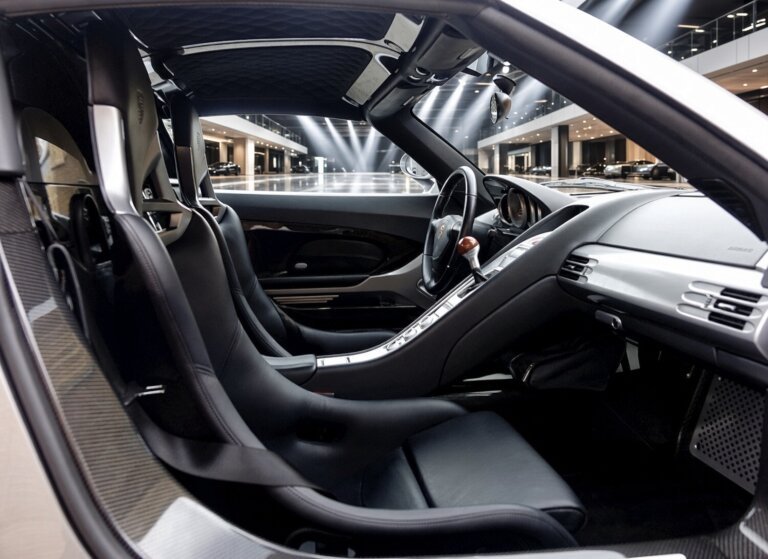
Power is transmitted through a six-speed manual gearbox featuring a compact ceramic clutch. The gear lever, topped with a distinctive laminated beechwood knob, became one of the car’s most memorable interior details — a tactile reminder of its motorsport inspiration.
Key Performance Specifications
- Engine: 5,733cc naturally aspirated 68-degree V10
- Power output: 612 PS (approximately 604 bhp) at 8,000 rpm
- Maximum torque: 590 Nm at 5,750 rpm
- Maximum engine speed: Approximately 8,400 rpm
- Transmission: Six-speed manual
- Clutch: Ceramic two-plate dry clutch
- Engine position: Mid-mounted
- Drive: Rear-wheel drive
- Chassis: Carbon-fibre-reinforced plastic monocoque
- Brakes: Porsche Ceramic Composite Brakes (PCCB)
- 0–100 km/h: Approximately 3.9 seconds
- Top speed: 330 km/h (205 mph)
- Kerb weight: Approximately 1,380 kg
These figures illustrate the extraordinary balance of power and lightweight construction that defined the Carrera GT when new.







Carbon-Fibre Construction — A Technical Milestone
The Carrera GT was notable for its extensive use of carbon-fibre-reinforced plastic. Its monocoque and structural unit carrier were made from this lightweight, high-strength material, marking a major milestone for Porsche’s series-production road cars.
Carbon fibre was complemented by other weight-saving solutions, including magnesium components and lightweight seat structures incorporating carbon fibre and Kevlar. The objective was to create a rigid, light platform capable of delivering precise handling and a direct response to driver inputs.
The suspension drew on racing principles, using double-wishbone geometry and pushrod-operated spring and damper arrangements. This layout helped Porsche engineers control wheel movement while maintaining the car’s low centre of gravity.
The combination of structural rigidity, advanced suspension and low mass gave the Carrera GT a distinctive character: exceptionally capable, but never detached from the driver.
Driving Experience — A Conversation Between Driver and Machine
The Carrera GT demands attention and rewards skill. Its naturally aspirated V10 builds power with revs, the manual gearbox requires deliberate engagement, and the chassis communicates the road with remarkable clarity.
Unlike many modern supercars, the Carrera GT offers relatively little electronic mediation between driver and machine. Its performance is therefore experienced directly through steering, throttle response, braking and the movement of the chassis.
The ceramic clutch and manual transmission form an essential part of this character. The car asks the driver to be precise, particularly when managing its substantial power and rear-wheel-drive layout. In return, it delivers a deeply involving experience that feels increasingly distinctive in an era of automated gearboxes and extensive electronic assistance.
Its reputation is not founded on speed alone. The Carrera GT is admired because its engineering makes the driver an active participant in the performance.
Interior & Craftsmanship — Purpose with Elegance
The Carrera GT’s cockpit reflects its dual identity as a racing-inspired machine and a high-end road car. The low seating position, sculpted seat shells and compact controls place the driver firmly within the car.
The instrument layout is clear and purposeful, while the distinctive wooden gear knob introduces a warm, tactile contrast to the carbon-fibre structure and technical surfaces. The removable roof panels can be stored in the front luggage compartment, adding practical versatility to the car’s dramatic design.
Materials and detailing are restrained rather than ostentatious. The emphasis is on quality, lightness and function — a philosophy that reinforces the Carrera GT’s status as a car designed around the driving experience.

History & Heritage — A Racing Dream Realised
Porsche presented the Carrera GT concept at the Paris Motor Show in September 2000. Its appearance signalled the marque’s ambition to bring racing-derived technology to a new generation of road-going supercars.
The production model made its world premiere at the Geneva Motor Show in March 2003. Manufacturing began later that year, with the cars assembled at Porsche’s Leipzig facility and their engines produced at Zuffenhausen.
Porsche initially planned a production run of 1,000 vehicles. Strong demand led to an expanded total, and 1,270 Carrera GTs were built between 2003 and May 2006.
The car’s engineering programme involved leading Porsche specialists, with renowned rally driver Walter Röhrl playing a key role in chassis development. Extensive testing helped ensure that the Carrera GT could deliver exceptional performance while remaining controllable and usable by skilled road drivers.
The Carrera GT became a landmark in Porsche’s modern history, demonstrating that the company could produce an uncompromising supercar while remaining faithful to its engineering principles.
Collectibility & Investment Appeal — An Increasingly Rare Breed
The Carrera GT occupies a special place among modern collector cars. Its naturally aspirated V10, manual gearbox and carbon-fibre construction give it a character that is difficult to replicate in today’s electronically managed supercars.
Its appeal is strengthened by its limited production, distinctive design and motorsport-derived engineering. The model has also become emblematic of an era in which manufacturers could pursue ambitious technical solutions without the same degree of electrification and automated driving systems found in contemporary performance cars.
For collectors, condition and provenance are essential. Service history, mileage, originality, accident records, paintwork, maintenance quality and evidence of specialist care can all have a substantial influence on desirability and value.
Cars with particularly low mileage or rare original specifications may attract significant premiums, although a well-maintained example with a transparent history can be more compelling than a low-mileage car whose condition or maintenance record is uncertain.
Market Value & Auction Perspective
The Carrera GT has become an important modern collector car, but values vary widely according to mileage, condition, specification, provenance and the circumstances of sale.
Recent auction activity has demonstrated that exceptional examples can command multi-million-dollar prices. A number of 2026 sales have exceeded US$3 million, while particularly notable cars have achieved substantially more. These results should not be interpreted as representative of every Carrera GT.
Collector-market perspective: Values should be assessed against recent completed sales of comparable cars, with careful attention to mileage, condition, originality, servicing and documented history. Asking prices are not the same as achieved auction prices.
Before publishing a firm valuation for an individual car, the most recent verified transactions and the vehicle’s specific history should be reviewed. The Carrera GT is a specialist purchase where provenance and mechanical condition can be just as important as mileage.
The Monaco Classic Cars Perspective
The Porsche Carrera GT represents an extraordinary moment in performance-car engineering: a naturally aspirated V10, a carbon-fibre monocoque and a manual gearbox brought together in a beautifully proportioned road car.
It was created to deliver the sensations of a racing machine while retaining the refinement expected of a Porsche flagship. Its design remains timeless, its engine remains one of the great modern naturally aspirated powerplants, and its driving experience continues to set it apart from contemporary supercars.
For the discerning collector, the Carrera GT is more than a rare Porsche. It is a celebration of mechanical purity and an enduring expression of the relationship between engineering and emotion.
Porsche Carrera GT — ten cylinders, six gears, one unforgettable connection between driver and machine.


Location Europe
We discreetly source and place vehicles of this calibre for private clients.
This page is for general information only and is not financial advice. Values vary widely by chassis, history and condition.